Dynamic Modeling of Raw Material Taxation in the Transition to a Circular Economy: An Optimal Control Framework for Toxic Externality Allocation

Document Type : Original Article

Authors
1 Department of Economics, Faculty of Management & Economics, Shahid Bahonar University of Kerman, Kerman, Iran.
2 Department of Economics, Faculty of Management & Economics, Shahid Bahonar University of Kerman, Kerman, Iran.
Abstract
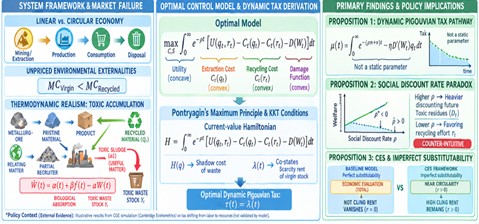
This paper presents a continuous-time optimal control model to determine the dynamic extraction taxes required to transition from a linear to a circular economy. It addresses the market failure where unpriced environmental externalities make virgin materials artificially cheaper than recycled alternatives.The analysis makes four main arguments: Dynamic Taxation: Using Pontryagin's Maximum Principle, the model demonstrates that optimal Pigouvian taxes on virgin materials must match the discounted present value of all future marginal environmental damages. Static taxes are inadequate. 1. Discount Rate Paradox: Counterintuitively, higher social discount rates increase optimal recycling intensity. This occurs because present-biased planners heavily discount the future environmental costs associated with toxic recycling residues. 2. Imperfect Substitution: Applying a CES production framework reveals that if virgin and recycled inputs are imperfect substitutes, 100% circularity is impossible. A strictly positive rate of virgin extraction must always remain part of the optimal path.3. Thermodynamic Realism: Instead of generic waste stocks, the model tracks specific toxic pollutant accumulation, capturing both primary depletion and the contamination inherent in secondary processing. Theoretical findings suggest that environmental tax reform specifically shifting the fiscal burden from labor to natural resource extraction can plausibly support ecological sustainability without triggering macroeconomic contraction. However, achieving this requires dynamically adjusted fiscal instruments that fully internalize the intertemporal shadow costs of environmental degradation.

Graphical Abstract

Dynamic Modeling of Raw Material Taxation in the Transition to a Circular Economy: An Optimal Control Framework for Toxic Externality Allocation
Keywords
Subjects

[1]      P. Söderholm. Conservation and Recycling, 2011, 55(11), 911-922. https://doi.org/10.1016/j.resconrec.2011.04.013
[2]      R. Boucekkine, F. El Ouardighi, Optimal Growth with Polluting Waste and Recycling, AMSE Working Papers 1513, Aix-Marseille School of Economics, 2015.https://shs.hal.science/halshs-01126636.
[3]      L. Milios. Circular Economy and Sustainability, 2021, 1(2), 477-498. https://doi.org/10.1007/s43615-020-00002-z
[4]      S. Bertarelli, C. Lodi, & S. Ragni. Decisions in Economics and Finance, 2023, 46(2), 681-711. https://doi.org/10.1007/s10203-023-00408-y.
[5]      H. Hotelling. The economics of exhaustible resources. Journal of Political Economy, 1931, 39(2), 137-175. https://www.jstor.org/stable/1822328.
[6]      G. Lafforgue, E. Lorang, Recycling under Environmental, Climate and Resource Constraints, TSE Working Papers 20-1125, Toulouse School of Economics, 2020.https://www.tse-fr.eu/publications/recycling-under-environmental-climate-and-resource-constraints.
[7]      G. Lafforgue, & E. Lorang. Resource and Energy Economics, 2022, 67, 101278-101289. https://doi.org/10.1016/j.reseneeco.2021.101278.
[8]      R. Boucekkine, F. El Ouardighi, Optimal growth with polluting waste and recycling. In: H. Dawid, K. F. Doerner, G. Feichtinger, P. M. Kort, A. Seidl, eds. Dynamic Perspectives on Managerial Decision Making. Springer, 2016, pp. 109-126. https://doi.org/10.1007/978-3-319-39120-5_7.
[9]      The Ex’tax Project, New Era. New Plan. Europe. A Fiscal Strategy for an Inclusive, Circular Economy, The Ex’tax Project Foundation, in cooperation with Cambridge Econometrics, Deloitte, EY, KPMG Meijburg, and PwC, 2016. https://www.ex-tax.com/new-era-new-plan-europe.
[10]    A. Borthakur. International Journal of Environment and Waste Management, 2016, 17(3/4), 301-317. https://doi.org/10.1504/IJEWM.2016.078600