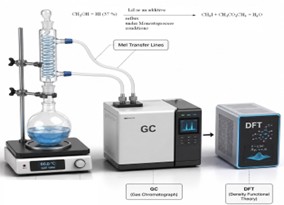
The Monsanto process is one of the most important industrial routes for acetic acid production, in which methyl iodide (CH₃I) serves as a key intermediate. In this study, lithium iodide (LiI) was investigated as a promoter for the conversion of methanol to methyl iodide under conditions analogous to those of the Monsanto process. The objective was to evaluate the effects of temperature, hydrogen iodide (HI) solution volume, LiI loading, and reaction time on the formation of CH₃I and on the overall composition of the reaction mixture. The HI solution used in the experiments contained 37% HI, 30% acetic acid, and 33% water under reflux conditions. Product distributions were monitored by gas chromatography at 2 h intervals over 6 h. The experimental results showed that temperature had a significant effect on methyl iodide formation, with 100 °C being identified as the optimum reaction temperature. The highest CH₃I concentration was obtained using 20 mL of HI, 20 mL of methanol, and 1.00 g LiI, giving 8.8% after 2 h and 9.1% after 6 h. Increasing the HI volume to 30 mL significantly reduced the CH₃I concentration to 1.6–2.2%, while using 2.00 g LiI gave 7.1–8.7% CH₃I. In the absence of LiI, CH₃I increased from 6.5% to 7.3%. A theoretical study based on density functional theory (DFT) conducted to examine the interactions of methanol with H⁺, Li⁺, HI, and LiI. The combined experimental and theoretical results indicate that LiI promotes methyl iodide formation and may improve the efficiency of Monsanto-process-related chemistry.
[3] A. R. G. Caranton, J. Dille, J. Barreto, F. Stavale, J. C. Pinto, M. Schmal, The European Society Journal of Catalysis, 2018, 10(22), 5256-5269. https://doi.org/10.1002/cctc.201801083
[4] A. Farhadi, M. Shareei, R. Mosayebi Behbahani, O. Hosseinkhani, S. Nasseri, Journal of Environmental Economics and Chemical Processes, 2026, 3, 87-93. https://doi.org/10.22034/jeecp.2026.2087997.1016
[7] J. L. Martín-Espejo, J. Gandara-Loe, J. A. Odriozola, T.R. Reina, L. Pastor-Pérez, Science of the Total Environment, 2025, 840, 156663-156679. https://doi.org/10.1016/j.scitotenv.2022.156663
[13] Q. Qian, M. Cui, Z. He, C. Wu, Q. Zhu, Z. Zhang, J. Ma, G. Yang, J. Zhang, B. Han, Chemical Science, 2015, 6, 5685-5689. https://doi.org/10.1039/C5SC02143B
[15] A. Haynes, P. M. Maitlis, G. E. Morris, G. J. Sunley, et al., Journal of the American Chemical Society, 2004, 126, 2847-2861. https://doi.org/10.1021/ja039464y
[20] I. Danaee, S. P Schwaminger, A. Farhadi, L. Vrsalović, M. Amarzadeh, Journal of Water Process Engineering, 2025, 79, 108878-108886. https://doi.org/10.1016/j.jwpe.2025.108878
Farhadi, A., Shareei, M. & Rashedi, F. (2026). Enhancing the Monsanto Process via Lithium Iodide Addition. Journal of Environmental Economics and Chemical Processes, 3(4), 229–232. https://doi.org/10.22034/jeecp.2026.2089265.1029
MLA
Farhadi, A., Shareei, M., & Rashedi, F. "Enhancing the Monsanto Process via Lithium Iodide Addition", Journal of Environmental Economics and Chemical Processes, 3, 4, 2026, 229–232. doi: 10.22034/jeecp.2026.2089265.1029
HARVARD
Farhadi, A., Shareei, M., & Rashedi, F. (2026). 'Enhancing the Monsanto Process via Lithium Iodide Addition', Journal of Environmental Economics and Chemical Processes, 3(4), pp. 229–232. doi: 10.22034/jeecp.2026.2089265.1029
CHICAGO
Farhadi, A., Shareei, M. & Rashedi, F., "Enhancing the Monsanto Process via Lithium Iodide Addition." Journal of Environmental Economics and Chemical Processes, 3 4 (2026): 229–232, doi: 10.22034/jeecp.2026.2089265.1029
VANCOUVER
Farhadi A., Shareei M., Rashedi F. Enhancing the Monsanto Process via Lithium Iodide Addition. J. Environ. Econ. Chem. Process. 2026;3(4):229–232. doi: 10.22034/jeecp.2026.2089265.1029
 Journal of Environmental Economics and Chemical Processes