Optimal Siting and Feasibility Analysis of Recycling Stations for Sustainable Urban Waste Management Using a GIS-Based Location–Allocation Model: A Case Study of Kerman City

Document Type : Original Article

Authors
1 Department of Water Engineering, Faculty of Civil and Surveying Engineering, Graduate University of Advanced Technology, Kerman, Iran.
2 b Department of Environmental Research, Institute of Science and high Technology and Environmental science, Graduate University of Advanced Technology,Kerman, Iran.
3 CEO of Waste Management Organization, Kerman Municipality, Kerman, Iran.
4 Department of Separation, Cleaning, Collection and Transportation of Waste, Kerman Municipality, Kerman, Iran.
Abstract
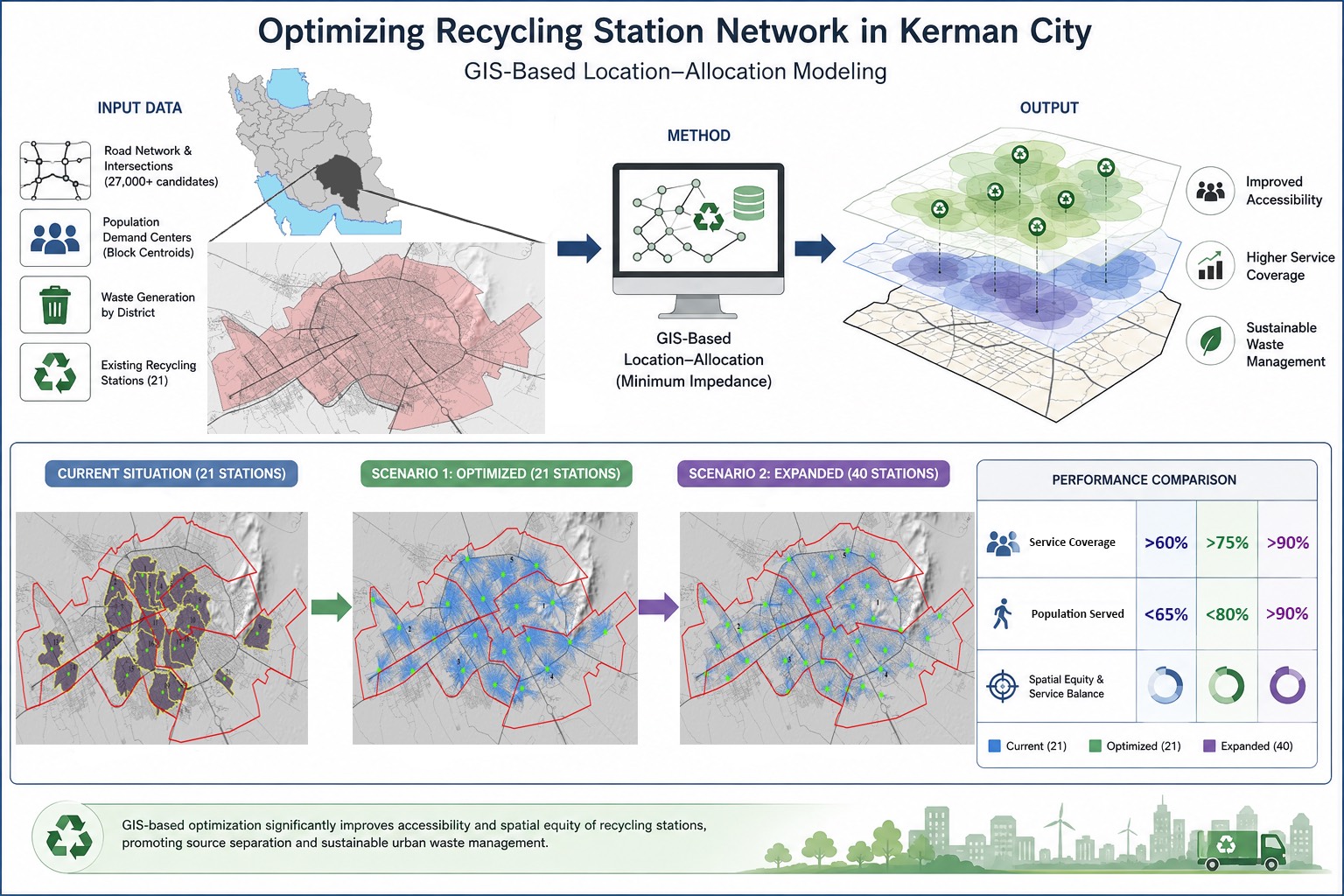
Developing effective recycling infrastructure is essential for sustainable municipal solid waste management, particularly in rapidly expanding urban environments. Recycling stations are pivotal in fostering source separation, boosting material recovery, and minimizing landfill dependence, though their success relies heavily on spatial accessibility and service coverage. This research evaluated and optimized the spatial distribution of recycling stations in Kerman, Iran, utilizing a Geographic Information System (GIS)-based Location–Allocation model. The study integrated urban road network data, population demand centers, waste generation rates across five municipal districts, and the specific locations of 21 existing recycling stations. Initial assessment of the current network revealed significant spatial imbalances, as numerous densely populated neighborhoods lacked adequate access to essential services. Consequently, two planning scenarios were examined: optimizing the existing 21 stations and expanding the network to 40 stations. The optimization scenario enhanced service coverage and accessibility without requiring additional facilities, underscoring the benefits of spatial reallocation for improving network performance. Furthermore, the expansion scenario proved highly effective, placing over 90% of residents within a 300-meter walking distance of a station while substantially mitigating service gaps in previously underserved areas. These findings demonstrate that integrating GIS-based spatial analysis with Location–Allocation modeling significantly improves spatial equity, encourages public participation in source separation initiatives, and bolsters the overall efficiency and long-term sustainability of municipal waste management systems within the city.

Graphical Abstract

Optimal Siting and Feasibility Analysis of Recycling Stations for Sustainable Urban Waste Management Using a GIS-Based Location–Allocation Model: A Case Study of Kerman City
Keywords
Subjects

[1]   G.Tchobanoglous, H. Theisen, S.Vigil, Integrated solid waste management: engineering principles and management issues. McGraw-Hill Companies, 1993, pp. 1-978.
[2]   United Nations Environment Programme (UNEP), Global Waste Management Outlook. Nairobi.(2025). https://www.unep.org/resources/report/global-waste-management-outlook
[3]   L. Billa, B. Pradhan, Pertanika Journal of Science and Technology, 2013, 21(2), 487-498.
[4]   A. Farahbakhsh, M. A. Forghani, Waste Management & Research,2019, 37(3), 287-300.
[5]   H. Vahidi, M. A. Bagherzadeh, E. Seyedi, Journal of Research in Environmental Health, 2024a, 10(2), 94-110.
[6]   H. Vahidi, M. BagherzadehKouhbanani, A. AliHosseini, Journal of Material Cycles and Waste Management, 2024b, 26(4), 2464-2477.
[7]   R. Church, C. ReVelle, Papers of the regional science association, 1974, 32(1), 101-118.
[8]   M. Daskin, Journal of the Operational Research Society, 1997, 48(7), 763-764.
[9]   A. Mussa, K. V. Suryabhagavan, Geology Ecology and Landscapes, 2021, 5(3), 186-198.
[10]  M. Ambaneh, Solid waste disposal site selection using gis and remote sensing: For Mojo town, Ethiopia, Unpublished Master’s Thesis at Addis Ababa University, Ethiopia, 2016.
[11]  B. Asefa, W. Mindahun, American Journal of Environmental Protection, 2019, 7(1), 17-23.
[12]  H. A. Kebede, W. A. Ayenew, Heliyon, 2023, 9(8), 1-12.
[13]  M. Ghobadi, M. Ahmadipari, M. Pazoki, Pollution, 2020, 6(3), 531-541.
[14]  S. Rahimi Madiseh, M. Ghalehnoee, A. Shahivandi, S. Hemati, International Journal of Environmental Health Engineering, 2021, 10(1), 1-7.
[15]  C. Wang, F. Zou, J. B.H.Yap, R. Tang, H. Li, Environmental monitoring and assessment, 2022, 194(7), 1-31.
[16]  J. Malczewski, GIS and multicriteria decision analysis. John wiley & sons,1999, pp.1-395.