Framework for Diversifying Investment in Iran's Propylene Value Chain

Document Type : Original Article

Authors
Department of Petroleum Economics and Energy Diplomacy, Tehran Faculty of Petroleum, Petroleum University of Technology (PUT), Abadan, Iran.
Abstract
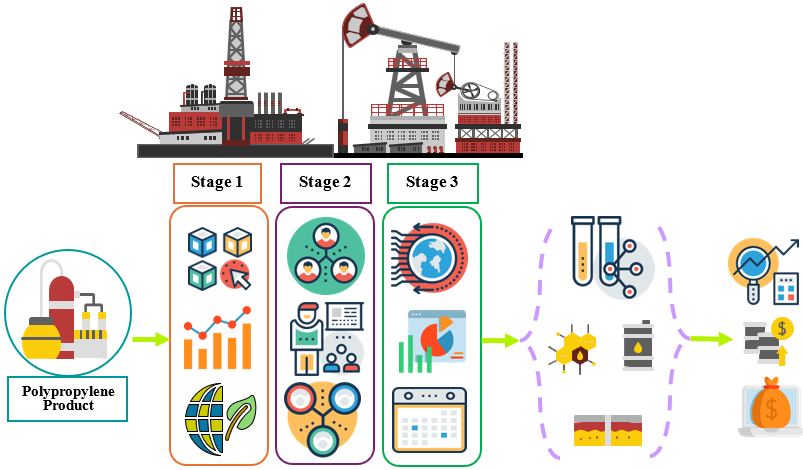
Iran's petrochemical industry relies almost exclusively on polypropylene, consuming over 95% of domestic propylene output. This monoculture exposes national revenues to volatile commodity cycles and forfeits higher margins from specialized derivatives. This study develops a hybrid three-stage Delphi-TOPSIS framework to rank alternative propylene derivatives for investment under Iran's sanctions-constrained economy. Stage One generates techno-economic and environmental data for Propylene Oxide (HPPO), Acrylonitrile (ACN), and Polyurethane (PU) using Aspen Plus simulations, COMFAR III financial analysis, and OpenLCA. Stage Two uses a two-round Delphi panel (n=15) of Iranian petroleum economists, industry executives, and environmental specialists to weight nine decision criteria. Stage Three applies TOPSIS to rank alternatives. Results show PO-HPPO as the preferred investment (closeness coefficient 0.630), robust across four sensitivity scenarios. The optimal portfolio allocates 35% of free propylene to PO, 29% to ACN, and 24% to PU. The paper provides the National Petrochemical Company with a validated quantitative framework for transitioning from commodity exporter to diversified high-value producer.

Graphical Abstract

Framework for Diversifying Investment in Irans Propylene Value Chain
Keywords
Subjects

[1]   NexantECA. Propylene value Chain: Technology, Economics, and Markets, 2023
[2]   National Petrochemical Company. Annual Statistical Report of the Petrochemical Industry, 2024. Tehran, Iran.
[3]   R. Syah, A. Davarpanah, M. Elveny, A. Ghasemi, D. Ramdan. Sustainability, 2021, 13(17), 99901-15.
[4]   Y. Gao, H. Li, Q. Xu, X. Zhang, S. Wang. Journal of Cleaner Production, 2024, 4(8), 1409431-22.
[5]   P. Shirzad, I. Kantor. Renewable and Sustainable Energy Transition, 2025, 7, 1000991-13.
[6]   Fortune Business Insights. Propylene Market Size, Share & Industry Analysis, 2025. Pune, India.
[7]   Verified Market Research. Propane Dehydrogenation (PDH) Market by Capacity & Region –,4(7), 223-256.
[8]   ICIS. China PDH Margins Sink to Decade Lows amid Oversupply, 2025. ICIS News.
[9]   K. Q. Al-Anazi, M. B. Shams, H. Al-Masri. Hydrocarbon Processing, 2024, 103(5), 45-52.
[10] Thyssenkrupp Uhde & Evonik Industries. HPPO Plants in China – Project Portfolio, 2023. Essen, Germany.
[11] S. D. Pohekar, M. Ramachandran. Renewable and Sustainable Energy Reviews, 2004, 8(4), 365-381.
[12] J. Ren, M. Lützen. Energy, 2017, 121, 803-815.
[13] Q. Wang, L. Zhan. Journal of Cleaner Production, 2019, 235, 1285-1296.
[14] C. Bai, J. Sarkis. International Journal of Production Research, 2020, 58(12), 3635-3653.
[15] C. L. Hwang, K. Yoon. Multiple Attribute Decision Making: Methods and Applications, 1981-12.