CFD Investigation of Hydrodynamics and Species Distribution in a Pilot-Scale Methanol-to-Olefins Fluidized Bed Reactor Using an Eulerian-RANS Model

Document Type : Original Article

Authors
Department of Gas Engineering, Ahvaz Faculty of Petroleum, Petroleum University of Technology (PUT), Abadan, Iran.
Abstract
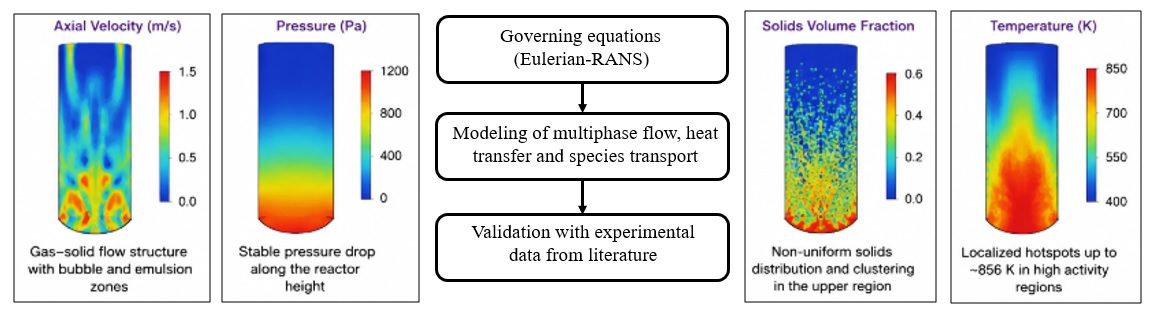
In the present study, a Computational Fluid Dynamics (CFD) model based on the Eulerian multiphase approach coupled with the Reynolds-Averaged Navier Stokes (RANS) turbulence model was developed to investigate the hydrodynamic and reactive behavior of a pilot-scale fluidized bed reactor for methanol-to-olefins (MTO) conversion. The model was used to analyze gas solid flow behavior, solids distribution, temperature and pressure fields, velocity profiles, and olefin formation within the reactor. The numerical results were validated against experimental data reported in the literature, showing satisfactory agreement, with most relative deviations remaining below 10%. The results revealed heterogeneous gas–solid flow behavior, including localized particle clustering and non-uniform solids holdup. Localized hotspots with temperatures of approximately 856 K were observed in regions of intensified catalytic activity and higher solids concentration. Ethylene and propylene concentrations reached maximum values of approximately 0.44 and 0.37, respectively, near the lower reaction zone and gradually decreased along the reactor height. The results indicate that local hydrodynamic structures and transport limitations strongly influence heat transfer, species distribution, and olefin formation. Overall, the developed Eulerian-RANS framework effectively captures the dominant multiphase transport phenomena and provides useful mechanistic insights for the analysis and design of pilot-scale MTO fluidized bed reactors.

The simulation results demonstrated satisfactory agreement with experimental measurements, with most relative deviations remaining below 10% for the principal hydrodynamic and thermal parameters. The predicted density distribution revealed heterogeneous gas–solid flow behavior characterized by localized particle clustering and non-uniform solids holdup within the upper reactor region. The thermal analysis showed the formation of localized hotspots with temperatures reaching approximately 856 K in regions associated with intensified catalytic activity and elevated solids concentration.
Species distribution analysis indicated that ethylene (C₂H₄) and propylene (C₃H₆) concentrations reached maximum values of approximately 0.44 and 0.37, respectively, near the lower reaction zone, followed by gradual reduction along the reactor height due to methanol depletion and product transport effects. The velocity and pressure distributions demonstrated stable fluidization behavior with acceptable pressure-drop characteristics and effective gas–solid interaction throughout the reactor. The results also highlighted the strong coupling between hydrodynamics, heat transfer, and catalytic reaction behavior, indicating that local flow structures significantly influence reactor thermal stability and olefin selectivity.

Graphical Abstract

CFD Investigation of Hydrodynamics and Species Distribution in a Pilot-Scale Methanol-to-Olefins Fluidized Bed Reactor Using an Eulerian-RANS Model
Keywords
Subjects

 
[1]      Z. Wan, S. Yang, J. Hu, H. Wang, Fuel, 2022, 327, 208-214.
[2]      W. Yu, P. Fede, M. Yazdanpanah, B. Amblard, F. Euzenat, O. Simonin, Chemical Engineering Science, 2020, 217, 472-480.
[3]      K. Jakobsen, Computational modeling of fluidized bed behavior with agglomerates, University of South-Eastern Norway , 2020.
[4]      A. Gil, I. Sancho-Sanz, S. Korili, Industrial & Engineering Chemistry Research, 2024, 63(27), 759–775.
[5]      H. Huang, H. Zhu, Q. Zhang, C. Li, Korean Journal of Chemical Engineering, 2019, 36(2), 210–216.
[6]      R. K. Thapa, A. Frohner, G. Tondl, C. Pfeifer, B. M. Halvorsen, Computers & Chemical Engineering, 2016, 92, 180–188.
[7]      W.E. Taifan, Catalytic Transformation of Ethanol to 1, 3-Butadiene over MgO/SiO2 Catalyst, Lehigh University, 2018.
[8]      N.S. Alosaimi, A. Althabet, I. Wazeer, M. Boumaza, M. K.Hadj-Kali, Processes, 2025, 13(12) , 6-21.
[9]      Y. Xu, B. Lu, M. He, W. Wang‏, Engineering, 2025, 13, 244-256.
[10]    H. Kim, H.G. Jang, E. Jang, S.J. Park, T. Lee, Y. Jeong, H. Baik, S.J. Cho, J. Choi‏ , Catalysis today, 2018, 303, 150–158.
[11]    M. Babaei, S. Movahedirad, Scientific Reports, 2023, 13(1), 49-50.
[12]    H.S. Cao, X.B. Zhang, Z.H. Luo, Chemical Engineering Science, 2025, 315, 83-92.
[13]    M.I. Malik, N. Abatzoglou, I.E. Achouri, Catalysts, 2021, 11(8), 893-899.
[14]    V.P. Sureshkumar, Intensifying Fatty Nitrile Hydrogenation: Unravelling Kinetics, Mass transfer, and Catalyst Deactivation, Eindhoven University of Technology, 2023.
[15]    Z. Wan, S. Yang, J. Hu, G. Bao, H. Wang, Energy, 2022, 243, 74-80.
[16]    A. Elwalily, E. Verkama, F. Mantei, A. Kaliyeva, A. Pounder, J. Sauer, F. Nestler, Sustainable Energy & Fuels, 2025, 9(19), 5151–5180.
[17]    B. Lu, J. Zhang, H. Luo, W. Wang, H. Li, M. Ye, Z. Liu, J. Li‏, Chemical Engineering Science, 2017, 171, 244–255.
[18]    B.R. Bakshi, Annual review of chemical and biomolecular engineering, 2019, 10(1), 265–288.
[19]    V. Angelidakis, S. Nadimi, M. Otsubo, S. Utili‏, SoftwareX, 2021,15, 735-744.
[20]    M.J. Lee, S. Kim, S.W. Kim, International Journal of Heat and Mass Transfer, 2023, 204, 58-64.
[21]    C. Yuan, K. Zhou, Y. Liu, W. Jiang, W. Jing, X. Ding, T.Yu, Z. Zhong, Y. Fan, W. Jin, W. Xing, Chemical Engineering Science, 2024, 296, 85-92.