Experimental Investigation on the Effect of Clay Minerals in the Drilling Fluid on Filter Cake Properties

Document Type : Original Article

Authors
Faculty of Petroleum and Natural Gas Engineering, Sahand University of Technology, Tabriz, Iran.
Abstract
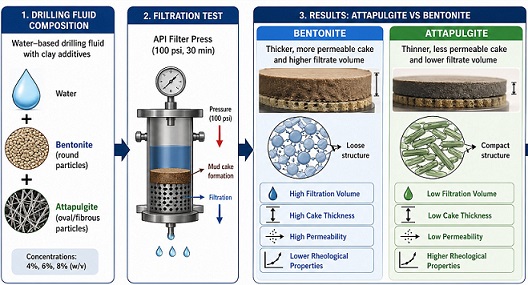
During the contact of drilling fluid with the formation rocks at the wellbore wall, base fluid is filtered through the rock, where solid components of the fluid are deposited on the rock surface to form a thin layer, called mud cake. Thin, low-permeability and low-porosity mud cakes are desirable to prevent further fluid filtration, provide wellbore stability and minimize stuck pipe possibility. In this study, water-based drilling fluids with the additive of two clay minerals, bentonite and attapulgite, are prepared and experimentally tested for filtration and rheological properties. Based on the results, it was found that drilling fluid with attapulgite additive had 56.2%, 16.1% and 55.8% lower filtration volume, cake thickness and cake permeability comparing to other fluids. Also, Drilling fluids with attapulgite have higher rheological characteristics compared to fluids with bentonite content. This can be due to the better dispersion characteristics of attapulgite. The better performance of the attapulgite is mainly related to its oval particle shape, where a more compact and less permeable cake can be built.

Graphical Abstract

Experimental Investigation on the Effect of Clay Minerals in the Drilling Fluid on Filter Cake Properties
Keywords
Subjects