1
Discipline of Chemical Engineering, School of Engineering, University of KwaZulu-Natal, Howard College Campus, King George V Avenue, Durban 4041, South Africa
2
Discipline of Chemical Engineering, School of Engineering, University of KwaZulu-Natal, Howard College Campus, King George V Avenue, Durban 4041, South Africa.
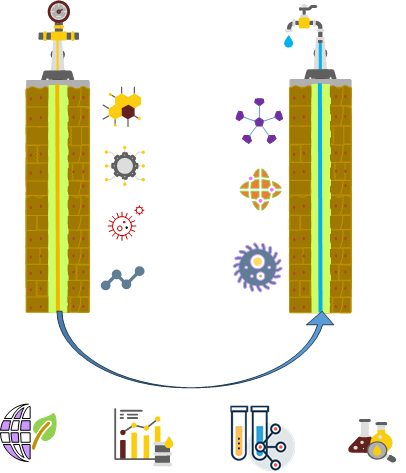
The development of green energy technologies to reduce greenhouse gas emissions has accelerated interest in enhanced coalbed methane recovery (ECBM). Conventional coalbed methane production causes significant environmental issues due to saline water extraction. ECBM offers a safer alternative by injecting gases such as carbon dioxide (CO₂) or nitrogen (N₂) into coal seams to improve methane recovery. CO₂ injection enhances methane displacement and enables carbon sequestration but causes coal swelling, reducing permeability and methane production rates. In contrast, N₂ injection improves injectivity and methane recovery through coal shrinkage, though it leads to faster nitrogen breakthrough and higher gas treatment costs. Studies show that injecting a CO₂–N₂ mixture provides a synergistic effect, combining improved methane recovery, enhanced injectivity, reduced swelling, and substantial CO₂ sequestration. Globally, several ECBM projects, particularly in the USA, demonstrate the feasibility of using flue gas mixtures. Although CO₂ separation costs remain a major economic challenge, suitable incentives for carbon storage could significantly improve the viability of CO₂- enhanced ECBM processes.
Moodley, T. & Mohammadi, A. H. (2026). An Overview of Enhanced Coalbed Methane Recovery. Journal of Environmental Economics and Chemical Processes, 3(1), 41–50. https://doi.org/10.22034/jeecp.2026.735101
MLA
Moodley, T., & Mohammadi, A. H. "An Overview of Enhanced Coalbed Methane Recovery", Journal of Environmental Economics and Chemical Processes, 3, 1, 2026, 41–50. doi: 10.22034/jeecp.2026.735101
HARVARD
Moodley, T., & Mohammadi, A. H. (2026). 'An Overview of Enhanced Coalbed Methane Recovery', Journal of Environmental Economics and Chemical Processes, 3(1), pp. 41–50. doi: 10.22034/jeecp.2026.735101
CHICAGO
Moodley, T. & Mohammadi, A. H., "An Overview of Enhanced Coalbed Methane Recovery." Journal of Environmental Economics and Chemical Processes, 3 1 (2026): 41–50, doi: 10.22034/jeecp.2026.735101
VANCOUVER
Moodley T., Mohammadi A. H. An Overview of Enhanced Coalbed Methane Recovery. J. Environ. Econ. Chem. Process. 2026;3(1):41–50. doi: 10.22034/jeecp.2026.735101
 Journal of Environmental Economics and Chemical Processes