DFT and TD-DFT Investigations of Tabun Gas Interactions with Pristine and Nitrogen-Doped Graphene for Environmental Cleanup Applications

Document Type : Original Article

Authors
Department of Applied Chemistry, Faculty of Science, Malayer University, Malayer, 65174, Iran.
Abstract
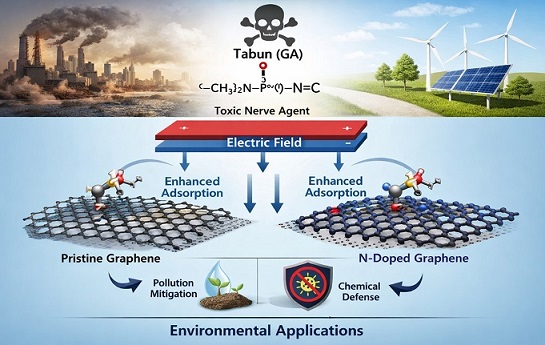
Density functional theory (DFT) calculations were performed to systematically elucidate the adsorption behavior, electronic properties, and sensing capability of the Tabun nerve agent on pristine and N-doped graphene under externally applied static electric fields. Optimized adsorption geometries obtained at the CAM-B3LYP/6-31G(d,p) level reliably describe long-range charge-transfer interactions. All complexes exhibit negative adsorption energies, confirming thermodynamically favorable, exothermic adsorption, with the interaction strength progressively enhanced as the electric field intensity increases (SEFz+0.00 to SEFz+0.03 a.u.), and indicating pronounced field-induced stabilization. Adsorption energies increase from −0.78 to −31.02 kcal mol⁻¹ for A-C-1 and from −1.68 to −58.26 kcal mol⁻¹ for B-N-2. Thermodynamic analyses further confirm the spontaneous and exothermic nature of all adsorption processes. Electronic structure results reveal band-gap reduction, spin polarization, density-of-states splitting, and decreased global hardness in doped systems, collectively indicating enhanced conductivity, polarizability, and charge-transfer efficiency. Time-dependent DFT calculations show pronounced red shifts in the absorption spectra of doped complexes, corresponding to reduced excitation energies and intensified absorption in the visible region. Complementary topological analyses based on AIM, ELF, RDG, and electrostatic potential mapping consistently demonstrate that adsorption is dominated by weak noncovalent interactions. Overall, N-doped graphene under tunable external electric fields emerges as a highly responsive and controllable platform for the efficient detection, monitoring, and capture of toxic organophosphorus agents in environmental sensing applications.

Graphical Abstract

DFT and TD-DFT Investigations of Tabun Gas Interactions with Pristine and Nitrogen-Doped Graphene for Environmental Cleanup Applications
Keywords
Subjects