International Trade, Income Inequality, and Ecological Efficiency: HPI Evidence from OPEC-Plus Countries

Document Type : Original Article

Authors
1 Department of Economics, Faculty of Economics and Administrative Sciences, Ferdowsi University of Mashhad, Mashhad, Iran.
2 PhD in Economics, Lecturer in the Department of Economics, Faculty of Administrative and Economic Sciences, Ferdowsi University of Mashhad, Iran.
3 Master in Economics, Department of Economics, Faculty of Administrative and Economic Sciences, Ferdowsi University, Mashhad, Iran.
Abstract
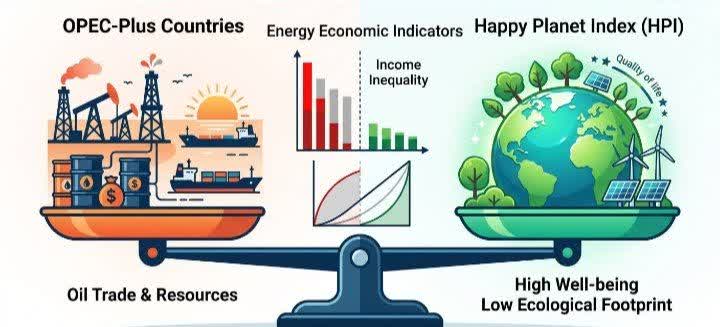
Environmental sustainability and ecological efficiency remain critical challenges for resource-dependent economies characterized by carbon-intensive trade and significant oil rents. This study investigates the impact of international trade openness and income inequality on the Happy Planet Index (HPI), a key environmental economics indicator that measures the efficiency of transforming natural resources (Ecological Footprint) into human well-being. Focusing on selected OPEC-Plus (OPEC+) countries from 2006 to 2020, we employ a dynamic panel data framework using the two-step System Generalized Method of Moments (GMM) to address endogeneity. The model evaluates how trade and social disparities affect the balance between experienced well-being and ecological limits. Results indicate that both trade openness and income inequality exert a statistically significant negative effect on HPI, suggesting that the current trade structures in these nations prioritize volume over environmental quality. Furthermore, oil resource rents and unemployment are found to exacerbate the ecological-social deficit, reinforcing the resource curse in a sustainability context. However, a positive interaction effect between trade and inequality suggests that trade may provide compensatory economic channels under high-inequality conditions. These findings underscore the urgent need for green trade reforms, inclusive redistribution, and policies aimed at decoupling economic growth from ecological degradation to foster long-term sustainable well-being in oil-producing regions

Graphical Abstract

International Trade, Income Inequality, and Ecological Efficiency: HPI Evidence from OPEC-Plus Countries
Keywords
Subjects