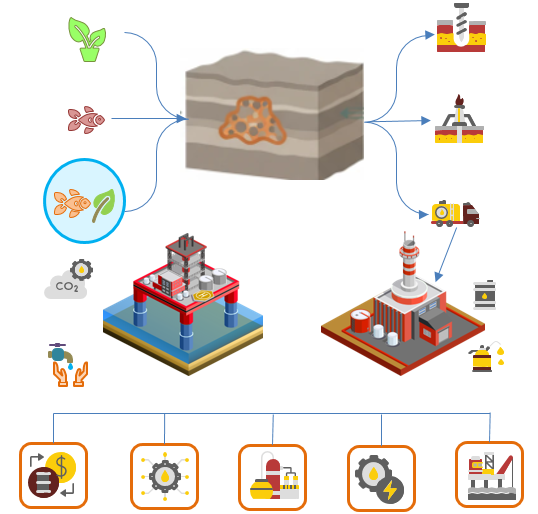
An Overview of Oil Shale Extraction and Processing

Authors
Discipline of Chemical Engineering, School of Engineering, University of KwaZulu-Natal, Howard College Campus, King George V Avenue, Durban 4041, South Africa
Abstract
Oil shale refers to a type of tough, dense rock which contains a variety of fine-grained sediments. It was formed over a lengthy geological period and contains a solid hydrocarbon known as kerogen. When this solid hydrocarbon becomes exposed to heat or becomes retorted, combustible gases, crude shale oil, and spent or retorted shale are formed. Oil shale is more commonly grouped into three main types of shale, namely terrestrial oil shale, formed in bogs and swamps, lacustrine oil shale, formed in lake bottoms, and marine oil shale, formed in ocean bottoms. Crude shale oil can either be extracted by in situ or ex-situ processes. The main in situ processes involve the True In Situ (TIS) process and the Modified In Situ (MIS) process, whilst the ex-situ process is known as the aboveground retorting (AGR) process. The TIS process involves fracturing the deposit with explosives, followed by retorting underground. The MIS process includes mining a portion of shale and then using explosives to fracture the rest of the deposit, followed by underground retorting. The AGR process includes mining the oil shale and retorting these mined deposits in heating vessels known as retorts. Oil shale mining can take one of two forms, namely surface mining or underground mining. Underground mining mainly uses the room and pillar method, whilst surface mining involves either open pit or surface mining, depending on the thickness of the overburden and stripping ratios of the deposit. Crude shale oil, once extracted, must be upgraded for transporting. The main upgrading procedures utilized include visbreaking, coking, hydrotreating, and additive additions. During the refining of crude shale oil, coking, hydrotreating, distillation, hydrocracking, catalytic cracking or reforming may be the procedures involved to extract usable fractions from the crude shale oil. When comparing mining techniques, it was found that underground mining, in comparison to surface mining, shows large possibilities for mechanization, with high production rates, much easier ventilation system requirements, more practical setups, minimal subsidence formation, and overall higher feasibility than surface mining. However, high economic input is required, and recoveries are reduced by the use of actual shale as pillars in the setup and also hampered by the overall impact caused by natural defects in the shale. The AGR process poses attractive advantages, including high recoveries, high controllability, simple recovery, and multifunctional units. However, high operating and safety costs are shown for the process due to crushing having to be carried out, limitations to high organic-matter-containing shale deposits to ensure cost viability, high environmental risks, high revegetation costs, and high capital investment requirements. In-situ processes ensure recovery from deep deposits, minimal mining costs in the case of TIS processing and lower costs for MIS processing, elimination of solid waste disposal issues, fewer limitations concerning processable shale, and greater economic viability. However, these processes prove difficult to control, accompanied by high drilling costs, poor recovery efficiencies, and the overall process being governed by the permeability and porosity of the shale. Environmental issues plague oil shale processing procedures as with any mining process. The main issues include dust and particulate matter emissions, mine waste disposal issues, hazardous air pollutant release, water quality issues, water requirements, subsidence, and reclamation problems. Concerning shale oil uses, it can be used as boiler fuel, as a refinery feedstock, and also as a petrochemical feedstock. However, logistical issues pose a large problem in all cases. Research and development are required in all processing cases and upgrading, distribution, and refining processes. The main areas include cost minimization, improved retorting procedures, finding the effects of different parameters such as creep on retorting, and also the effects of heavy metals on retorting and refining processes. Furthermore, the feasibility of using additives to improve crude shale oil pour point is required. Finally, logistical and distribution patterns must be addressed to improve the usability of shale oil.

Graphical Abstract

An Overview of Oil Shale Extraction and Processing
Keywords
Subjects

[1] V. Allred, Oil Shale Processing Technology, New Jersey, 1982.
[2] G. Baughman, Synthetic Fuels Data Handbook. 2nd ed. Denver: Cameron Engineers Inc., 1978.
[3] S. Lee, Alternative Fuels. Washington: Taylor & Francis Publishers, 1996.
[4] C. Scouten, Part IV: Oil Shale. In: Fuel Science and Technology Handbook. New York: Marcel Dekker Inc., 1990.
[5] J. Speight, Shale Oil Production Processes. 1st ed. Waltham: Elsevier Inc., 2012.
[6] J. Dyni, Oil Shale, 2003, 20(3), 193-252.
[7] J. Speight, The Chemistry and Technology of Coal. 3rd ed. Florida: CRC-Taylor & Francis Group, 2013.
[8] J. Speight, The Chemistry and Technology of Petroleum. 4th ed. Florida: CRC-Taylor & Francis Group, 2007.
[9] A. Andrews, Oil Shale: History, Incentives, and Policy, Washington: Congressional Research Service, 2006.
[10] J. Bartis, T. LaTourrette, L. Dixon, Oil Shale Development in the United States: Prospects and Policy Issues, California: Rand Corporation, 2005.
[11] W. Culbertson, J. Pitman, Oil Shale in United States Mineral Resources, Washington, 1973.
[12] J. Dyni, Oil Shale. In: 2010 Survey of Energy Resources. World Energy Council, 2010.
[13] Hutton, A., Petrographic classification of oil shales. Int. J. Coal Geol., 1987, 8, 203- 231.
[14] G. Mason, Fractional Differentiation of Silicate Minerals During Oil Shale Processing: a Tool for Prediction of Retort Temperatures, Colorado, 2006.
[15] B. Tissot, D. Welte, Petroleum Formation and Occurrence. New York: Springer- Verlag, 1978.
[16] M. Koel, S. Ljovin, K. Hollis, J. Rubin, Pure and Applied Chemistry, 2001, 73(1), 153-159.
[17] B. Durand, Kerogen: Insoluble Organic Matter from Sedimentary Rocks. Paris: Editions Technip., 1980.
[18] T. Beard, D. Tait, J. Smith, Nahcolite and Dawsonite Resources in the Green River Formation, Piceance Creek Basin, Colorado. Colorado, Rocky Mountain Association of Geologists, 1974, 101-109.
[19] R. Bozak, M.Garcia Jr., Journal of Chemical Education, 1976, 53(3), 154- 155.
[20] A. Hubbard, W. Robinson, A Thermal Decomposition Study of Colorado Oil Shale, Washington, 1950.
[21] A. Burnham, J. McConaghy, Comparison of the Acceptability of Various Oil Shale Processes, Florida, 2006.
[22] J. Janka, J. Dennison, Devonian Oil Shale in Symposium Papers: Synthetic Fuels from Oil Shale. Georgia, 1979, 21-116.
[23] S. Rattien, D. Eaton, Annual Review of Energy, 1976, 183-212.
[24] V. Yefimov, T. Purre, Oil Shale, 1993, 10(4), 313-319.
[25] M. Essington, L. Spackman, J. Harbour, K. Hartman, Physical and Chemical Characteristics of Retorted and Combusted Western Reference Oil Shale, Washington, 1987.
[26] C. Milton, The Mineralogical Record, 1977, 8, 368-379.
[27] J. Smith, W. Robb, N. Young, High Temperature Mineral Reactions of Oil Shale Minerals and Their Benefit to Oil Shale Processing in Place. CO, Colorado School of Miners, 1978, 100-112.
[28] J. Dyni, Geology and Resources of Some World Oil Shale Deposits, VA: United States Geological Survey, 2006.
[29] P. Allix, A. Bumham, T. Fowler, M. Herron, B. J. O. R. Symington, Oilfield Review, 2010, 22(4), 4-15.
[30] G. Chilingarian, T. Yen, Bitumens, Asphalts, and Tar Sands. Amsterdam: Elsevier, 1978.
[31] D. E. Anders, F. G. Doolittle, W. E. Robinson, Geochimica et Cosmochimica Acta, 1975, 39(10), 1423-1430.
[32] D. E. Anders, W. E. Robinson, Geochimica et Cosmochimica Acta, 1971, 35(7), 661-678.
[33] P. C. Anderson, P. M. Gardner, E. V. Whitehead, D. E. Anders, W. E. Robinson, Geochimica et Cosmochimica Acta, 1969, 33(10), 1304-1307.
[34] J. Fester, W. Robinson, Coal Science, 1966, 22.
[35] D. Vitrovic, Paris: Editions Technip, 1980, 301.
[36] J. Schmidt-Collerus, C. Prien, Fuel Chemistry, 1974, 19(2), 100.
[37] A. Hubbard, J. Fester, Industrial & Engineering Chemistry, 1958, 3, 147-152.
[38] B. Simoneit, A. Burlingame, Paris: Editions Technip, 1974, p. 191.
[39] M. Siskin, G. Brons, J. Payack, Division of Petroleum Chemistry, 1987, 32(1), 75.
[40] F. Behar, M. Vandenbroucke, Organic Geochemistry, 1987, 11, 15-24.
[41] A. Barakat, T. Yen, Energy Fuels, 1988, 2, 105-108.
[42] L. Johns, et al., An Assessment of Oil Shale Technologies. Washington: Holmes, J.C., 1980.
[43] J. Lankford, C. Ellis, Industrial and Engineering Chemistry, 1951, 43(1), 27-32.
[44] A. Mohsenatabar, G. Zargar, A. Khaksar Manshad, A. H. Mohammadi, Petroleum & Coal, 2019, 61(1), 1-9.