Comparative Study of Isobutyl Acetate and Ethyl Acetate as Azeotrope-Breaking Agents in Acetic Acid–Water Separation

Document Type : Original Article

Authors
1 Shahid Tondgouyan Petrochemical Company, Mahshahr, Iran
2 Department of Gas Engineering, Ahvaz Faculty of Petroleum, Petroleum University of Technology, Ahvaz, Iran.
Abstract
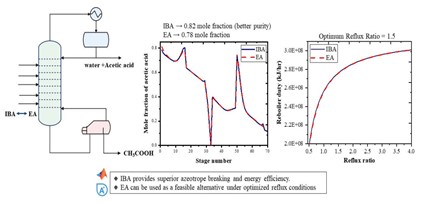
Acetic acid is one of the most important industrial chemicals due to its broad applications and high economic value. However, its separation from water remains a major challenge because of azeotrope formation, which restricts the performance of conventional distillation methods. In this study, the separation of acetic acid and water in a distillation column was simulated and analyzed to evaluate and optimize the performance of an industrial-scale process. The process modeling was carried out using Aspen Plus (Version 12) employing a RadFrac distillation column with 72 theoretical stages and a kettle-type reboiler, while MATLAB was utilized for post-simulation data analysis and process optimization. The effects of two different entrainers-isobutyl acetate (IBA) and ethyl acetate (EA)-on separation efficiency and energy consumption were investigated in detail. Simulation results indicated that using IBA achieved a bottom product purity of 0.82 mole fraction, closely matching the design target of 0.85, whereas substituting it with EA slightly decreased the purity to 0.78, corresponding to a 4% reduction in separation efficiency. Temperature and composition profiles confirmed that IBA provided more stable operation and better agreement with expected industrial performance. Furthermore, MATLAB-based optimization revealed that a reflux ratio of 1.5 offers the most favorable trade-off between acetic acid purity and reboiler energy duty, minimizing energy consumption without sacrificing separation quality. The findings demonstrate that isobutyl acetate remains the superior entrainer for acetic acid–water separation, while ethyl acetate can serve as a viable alternative under optimized operating conditions without requiring equipment modification.

Graphical Abstract

Comparative Study of Isobutyl Acetate and Ethyl Acetate as Azeotrope-Breaking Agents in Acetic Acid–Water Separation
Keywords
Subjects