Investigation New Anionic Surfactant and Cationic Surfactant Effect on Relative Permeability Curves

Document Type : Original Article

Authors
1 Department of Petroleum Engineering, Ahvaz Faculty of Petroleum Engineering (AIT), Petroleum University of Technology, Ahvaz, Iran.
2 Department of Petroleum Engineering, Abadan Faculty of Petroleum, Petroleum University of Technology (PUT), Abadan, Iran.
3 Department of Petroleum Engineering, Abadan Faculty of Petroleum Engineering (AIT), Petroleum University of Technology, Abadan, Iran.
Abstract
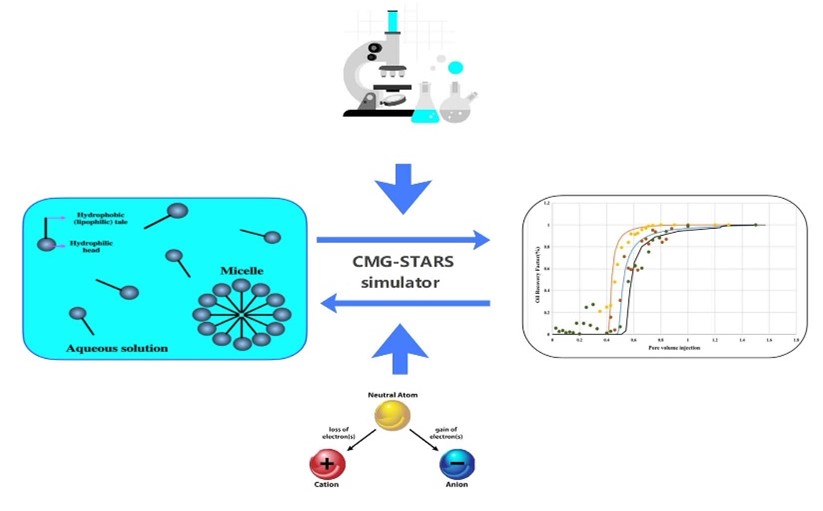
Surfactants have been considered as chemical EOR processes for enhanced oil recovery by reduced oil-water interfacial tension. However, these surfactants may enhance oil recovery via wettability alteration as well. Due to changes in wettability and interfacial tension, the relative permeability of oil and water and recovery of oil was changed where several fluids flow in porous media. This study investigates the effect of anionic and cationic surfactants and their effect on the wettability of sandstones in the presence of oil and water. The effect of these surfactants on the relative permeability (relative two-phase permeability) of several methods and correlations were discussed. Also, comparing the relative permeability data obtained from these methods with the relative permeability diagrams obtained from the CMG-STARS simulator (which was plotted using the Corey method) to find the method closest to the simulation curves was described. To investigate this factor, several core flood experiments were performed using the sandstone core of Bangestan oil reservoir by a core-flood apparatus. Results of this study demonstrated that the cationic Dodecyl Trimethyl Amino Bromide and anionic Dodecyl-Amino-Benzene Sulfonic Acid alter wettability of sandstone rocks to more water-wet, reduced relative permeability of water and relative permeability of oil was increased. Therefore, these surfactants enhanced recovery of oil in rocks. But the experiment show that the Dodecyl-Amino-Benzene sulfonic Acid surfactant have more effect on relative permeabilities and recovery. In addition, according to the results of Honarpour et al method, the closest method of calculating the relative permeability curves to the relative permeability curves obtained from the simulator was obtained.

Graphical Abstract

Investigation New Anionic Surfactant and Cationic Surfactant Effect on Relative Permeability Curves
Keywords
Subjects

[1]  D. W. Green, G. P. Willhite, Enhanced Oil Recovery. Textbook series, SPE, Vol. 6, Richardson, TX, 1998.
[2]  J. R. Fanchi, Principles of Applied Reservoir Simulation, Gulf Professional Publishing, 2001.
[3]  A. Roustaei, Investigating the Effect of Polysilicon Nano Powders in Waterflooding. M.Sc. Thesis, Petroleum University of Technology, Abadan Faculty of Petroleum Engineering, Abadan, Iran, 2012.
[4]  ARI: Basin Oriented Strategies for CO2 Enhanced Oil Recovery: Onshore Gulf Coast, Prepared for U.S. Department of energy office of Fossil Energy – Office of Oil and Natural Gas by Advanced Resources International, February, 2006.
[5]  Schramm, L. Laurier, N. Elaine G. D. Marangoni, Surfactants and Their Applications, Physical Chemistry and Chemical Physics Research, Section 3, 2003, Vol. 99, 3-48.
[6]  A. K. Abdulla, Impact of Wettability Alteration on Recovery Factor. SPE Conference Paper, SPE/DGS Saudi Arabia Section Technical Symposium and Exhibition, Al-Khobar, Saudi Arabia, 15-18 May, 2011.
[7]  Ayirala, C. Subhash, Surfactant-induced relative permeability modifications for oil recovery enhancement. PhD diss., IIT, Kharagpur, India, 2002.