Effect of Income Distribution on Environmental Pollution Growth

Document Type : Original Article

Authors
1 Department of Economics, Azad University, Central Tehran Branch, Iran.
2 Department of Economics and Islamic Banking, Kharazmi University, Iran.
Abstract
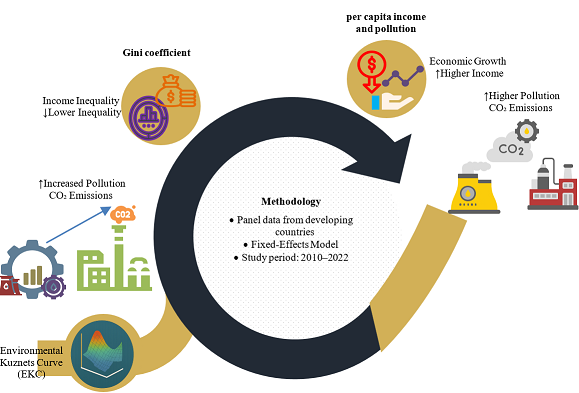
This research investigates the relationship between income distribution (measured by the Gini coefficient) and environmental pollution, specifically CO2 emissions, in a panel of developing countries (2010-2022). The study acknowledges that economic growth, often leading to increased resource consumption and pollution, necessitates sustainable development planning. It reviews existing theories like the Environmental Kuznets Curve (EKC), which posits that pollution initially rises with income before falling due to structural and technological shifts. Employing panel data analysis, the researchers utilized fixed-effects models after rejecting the pooled and random-effects specifications via Chow and Hausman tests. The key finding is a statistically significant negative relationship between the Gini coefficient and environmental pollutants, meaning that reduced income inequality is associated with increased pollution. Conversely, a positive and significant relationship exists between per capita income and pollution, indicating that as these developing nations increase production and income, pollution levels rise. The conclusion suggests that for these developing economies, efforts to increase per capita income and reduce inequality (lower Gini) currently result in greater environmental degradation, likely due to production methods heavily reliant on polluting, energy-intensive industries. Policymakers are advised to focus on strategies that decouple income growth from pollution, such as moving beyond raw material processing toward higher-value, cleaner industries.

Graphical Abstract

Effect of Income Distribution on Environmental Pollution Growth
Keywords
Subjects

[1] K. U. Ehigiamusoe, M. T. Majeed, E. Dogan, Journal of Cleaner Production, 2022, 341, 130863.
[2] A. Zhou, J. Li, Environmental Science and Pollution Research, 2021, 28(7), 8392-8406.
[3] Y. Liu, J. Wang, Environmental Science and Pollution Research, 2020, 27(36), 45161-45174.
[4] X. Yang, L, Geng, K. Zhou, Environmental Science and Pollution Research, 2020, 27(27), 34211-34222.
[5] W. Zhao, M. Hafeez, A. Maqbool, S. Ullah, S. Sohail, Environmental Science and Pollution Research, 2021, 28(37), 51199-51209.
[6] H. Ansari Samani, M. Rouzbahani, H. Dalvandi, R. Sadeghi, Environmental Health Engineering And Management Journal, 2024, 11(1), 25-30.‏
[7] Z. He, J. Li, B. Ayub, Heliyon, 2024, 10(13).
[8] S. Khan, W. Yahong, A. Zeeshan, Energy Reports, 2022, 8, 670-679.
[9] D. Xiao, F. Yu, H. Yang, Complexity, 2022, 1, 4604467.
[10] L. Liao, Y. Li, Journal of Cleaner Production, 2025, 506, 145532.
[11] B. Ma, Sustainability, 2022, 15(1), 637.‏
[12] L. Luo, X. Ma, Research on the impact of income gap on environmental pollution based on balanced panel data of 48 countries. In IOP Conference Series: Earth and Environmental Science (Vol. 781, No. 3, p. 032003). IOP Publishing, (2021, May).
[13] B. Li, D. Xiao, International Journal of Environmental Research and Public Health, 2021, 18(15), 8090.