Assessing Risks and Uncertainties in Chemical EOR along with Identifying Handling Options

Document Type : Original Article

Authors
1 Tehran Faculty of Petroleum, Petroleum University of Technology, Tehran, Iran.
2 Department of Chemical and Petroleum Engineering, Sharif University of Technology, Tehran,11365-9465, Iran.
Abstract
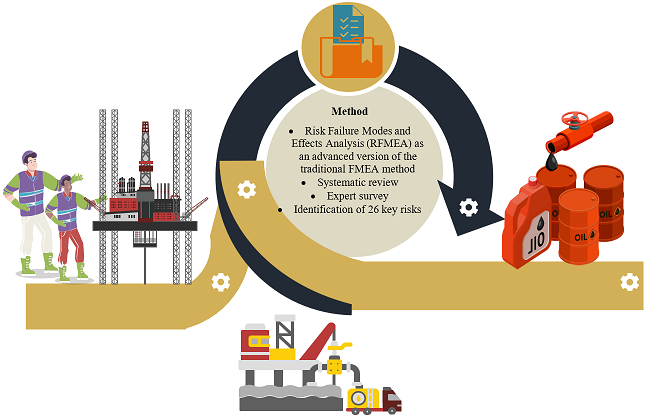
Chemical Enhanced Oil Recovery (CEOR) is a complex, multi-phase technique that enhances hydrocarbon recovery by injecting chemicals such as polymers, surfactants, and alkalis into reservoirs. Despite its potential, CEOR faces significant technical, economic, and operational risks, especially during early project development. Effective risk management is essential to ensure success, and pilot testing plays a key role in validating reservoir response and chemical performance before full-scale deployment. This study applies the Risk Failure Modes and Effects Analysis (RFMEA), an advanced version of traditional FMEA, to systematically identify, assess, and prioritize CEOR project risks. Through a comprehensive literature review and expert surveys, 26 key risks were identified and classified into four categories: general CEOR risks, offshore-specific risks, polymer flooding risks, and risks related to chemical combinations. The analysis revealed that permeability reduction, high salinity in offshore settings, reservoir heterogeneities, polymer and chemical adsorption, and polymer yield are the most critical factors affecting CEOR efficiency. These risks can impair fluid mobility, reduce chemical effectiveness, and increase project costs. RFMEA enables a structured evaluation of these risks, helping decision-makers prioritize mitigation actions, optimize chemical formulations, and improve project outcomes. The study emphasizes the importance of integrating RFMEA into the early planning phase of CEOR projects to reduce uncertainties, enhance reliability, and maximize recovery efficiency. By proactively addressing risks, operators can increase the likelihood of successful CEOR implementation and achieve better economic returns. The findings support the use of systematic risk assessment tools in complex oil recovery operations, particularly in challenging environments such as offshore reservoirs.

Graphical Abstract

Assessing Risks and Uncertainties in Chemical EOR along with Identifying Handling Options
Keywords
Subjects

[1] M. Abu El Ela, H. Sayyouh, E. El Tayeb, Journal of Petroleum Science Research, 2014, 3, 176-188.
[2] I. Lakatos, J. Lakatos-Szabó, International Journal of Oil, Gas and Coal Technology, 2008, 1, 46-64.
[3] A. Flaaten, PhD Thesis, The University of Texas at Austin, Austin, 2008.
[4] C. Chai, G. Adamson, S. Lo, B. Agarwal, S. Ritom, K. Du, W. Mekarapiruk, 2011, 144594, 7, 1-9.
[5] A. Alkhatib, M. Babaei, P. R. King, SPE Journal, 2013, 18, 721-735.
[6] J. J. Taber, F. D. Martin, R. S. Seright, SPE 39234, 1997.
[7] Project Management Institute, A Guide to the Project Management Body of Knowledge, 5th edn, PMI, Newtown Square, PA, 2013.
[8] Y. Zhu, SPE 174566-MS, 2015.
[9] K. Rany, S. Ayirala, R. Chin, P. Verbeek, SPE Production and Operations, 2012, 27, 294-305.
[10] O. Adepoju, H. Hussein, C. Chawathe, SPE 182596-MS, 2017.
[11] J. Cheng, X. Sun, W. Bao, J. Liu, SPE 108661, 2007.
[12] H. I. Chang, Z. Q. Zhang, Journal of Petroleum Technology, 2006, 58, 84-89.
[13] M. Nobili, C. Callegaro, E. Kosourova, Proc. Offshore Mediterr. Conf. Exhib., Ravenna, Italy, 2015, 1-13.
[14] D. Morel, M. Vert, A. Hayden, S. Jouenne, R. Gauchet, Y. Bouger, SPE, 2010.
[15] M. Othman, M. Chong, SPE 109033, 2007.
[16] S. Ghasemi, R. Mahmoudvand, K. Yavari, Stochastic Environmental Research and Risk Assessment, 2015, 29, 737-745.
[17] T. A. Carbone, D. D. Tippett, Engineering Management Journal, 2004, 16, 28-35.
[18] P. R. Garvey, INCOSE Insight, 2001, 4, 15-22.
[19] R. D. Kaminsky, R. C. Wattenbarger, R. C. Szafranski, A. S. Coutee, IPTC 11200, 2007.
[20] Du, B. Agarwal, S. Lo, S. Ritom, W. Mekarapiruk, SPE 144655, 2011.
[21] N. Zakaria, N. Ghadami, S. Berok, M. Sedaralit, M. Raum, SPE 18858-MS, 2016.
[22] Y. Zhang, Z. P. Fan, International Journal of Project Management, 2013, 31, 1-11.
[23] A. Kamari, A. H. Mohammadi, Handbook on Oil Production Research, 2014, 285-295.
[24] J. R. Hite, M. L. Blanton, M. Kuhlman, W. Fair, SPE 152700, 2012.
[25] J. R. Wilkinson, G. F. Teletzke, K. C. King, SPE 101679, 2006.
[26] V. Alvarado, G. Thyne, G. Murrel, SPE 115940, 2008.